


Inside Story

![[Design] What kind of shape does a camera have --as a photographic tool--?](/english/r_dc/r/r8/story/03/img/cts_top_02.jpg)
- Planning
- High Performance
- Design
What is a "camera that looks and acts like a camera?"
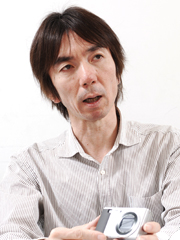
"We wanted to come up with
a tool that users would carry
with them everyday." (Tatsuo Okuda)
More than a month has passed since the R8 was launched. Though it has been highly applauded from the functional side, it has stirred a great deal of talk and won the approval of users because its design is greatly different from its predecessor model. Design team leader, Tatsuo Okuda, confessed to us: "I am so relieved that users have understood the concepts." Those concepts were "a camera as a photographic tool" and "a camera that looks and acts like a camera". As Okuda tells, "We aimed for a camera that would inspire people to take pictures." But, how did the design team tangibly shape the concepts expressed in such abstract words?
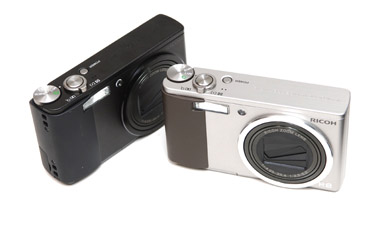
The R8 is liked by users because it's "cool!"
Injecting novelty into tradition
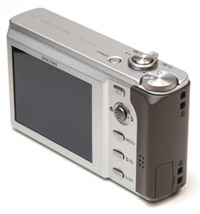
The R8 pursues functional beauty.
"To make it look like a high-end camera, we adopted a top cover that was not used on the predecessor model," says Okuda. The predecessor Caplio R7 looked like a "Sandwich" because of the matching front and back covers. On the other hand, the R8 adds another cover on top of that.
Cameras with a top cover follow in the footsteps of the "traditional" form of 35 mm film cameras. "Adding a top cover increases costs and manufacturing processes, but we were hooked on this style with the R8," tells Okuda. "Then, we brought out an advanced high grade look by making the top cover thinner, hiding the screws that hold it down and using hairline processing," he adds.
A hairline is a pattern that looks like it has been wiped with a brush. Actually, the outer material of the R8 is the same as the Caplio R7. Nonetheless, because of the hairline processing on the top face, the R8 has a completely different look -- sharp yet thick-boned -- than the Caplio R7. Okuda said, "This processing emphasizes the metal and produces a durable look."


- Planning |
- High Performance |
- Design