


Inside Story


- Planning
- High Performance
What delivers the high performance?
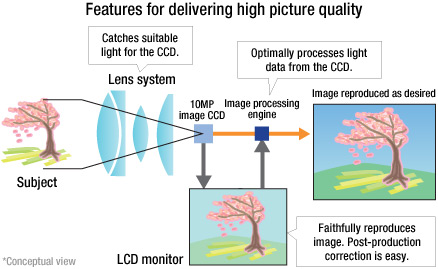
The concepts of the R8 were a "camera that worked as a camera" and a "camera as a tool" or, in other words, a camera that can capture "works". In this case, the performance demanded above everything else is "high picture quality". For that reason, a 10MP CCD was chosen. That means an image is defined by 10 million pieces of data. Naturally, the lens system for conveying the image to the CCD had to evolve and the image processing engine that processed the light data captured by the CCD needed tuning. Furthermore, features that reflected the intentions of users were demanded. Delivering all of this at high performance would mean a camera that takes pictures "just as the user envisioned". So, how did the development team pursue high performance?
A combination of special lenses

"We enabled high resolution by
combining a number of quality
lenses into a lens system." (Kazuyasu Ohashi)
Let us first take a look at the lens system that catches the light. "The biggest task was how to design the lens to accurately transfer a wide array of images -- from 28 mm wide angle shots that encompass a broad field to 200 mm telephoto shots that close up on the subject -- to a 10MP CCD and still house it in a compact body," tells lens design staff Kazuyasu Ohashi. Compared to the 8MP predecessor Caplio R7, the CCD of the R8 was higher resolution and larger in size. The light transferred to that CCD by the lens would determine picture quality.
In explaining the lens system of 7 groups and 10 elements, Ohashi said, "several lenses featured by their materials and processing method were selected -- high refractive glass, aberration dispersion glass, aspherical surfaces and so forth -- in order to create a 7.1x zoom from a wide angle lens housed in a compact body." He added, "With zoom lenses of high magnification ratio, color aberrations readily occur around the image periphery on the wide angle end, while color runs easily occur across the entire image when taken from the telephoto end. We made it possible even with a 10MP CCD to produce high resolution all the way to the edges without these phenomena being conspicuous."
By building in precision
"We also worked with the production method in order to deliver this lens system as a product to users," tells Ohashi. A process was built to properly and assuredly check and adjust lens axis alignment and pursue precision of each individual lens. "We created a scheme for making a high precision lens system for the production line start, which made us feel very content about providing users with a good product," tells Ohashi.
- *All lens focal distance in this text have been converted to 35 mm film.


- Planning |
- High Performance